
What is short covering? It is the process of closing an existing short position by buying back the contract or security that was sold earlier.
That sounds simple, but many traders still misread short covering because they focus only on price direction.
A rising price does not always mean fresh bullish conviction. Sometimes the move is happening because earlier short sellers are exiting their positions.
That is the real meaning of short covering.
What short covering means
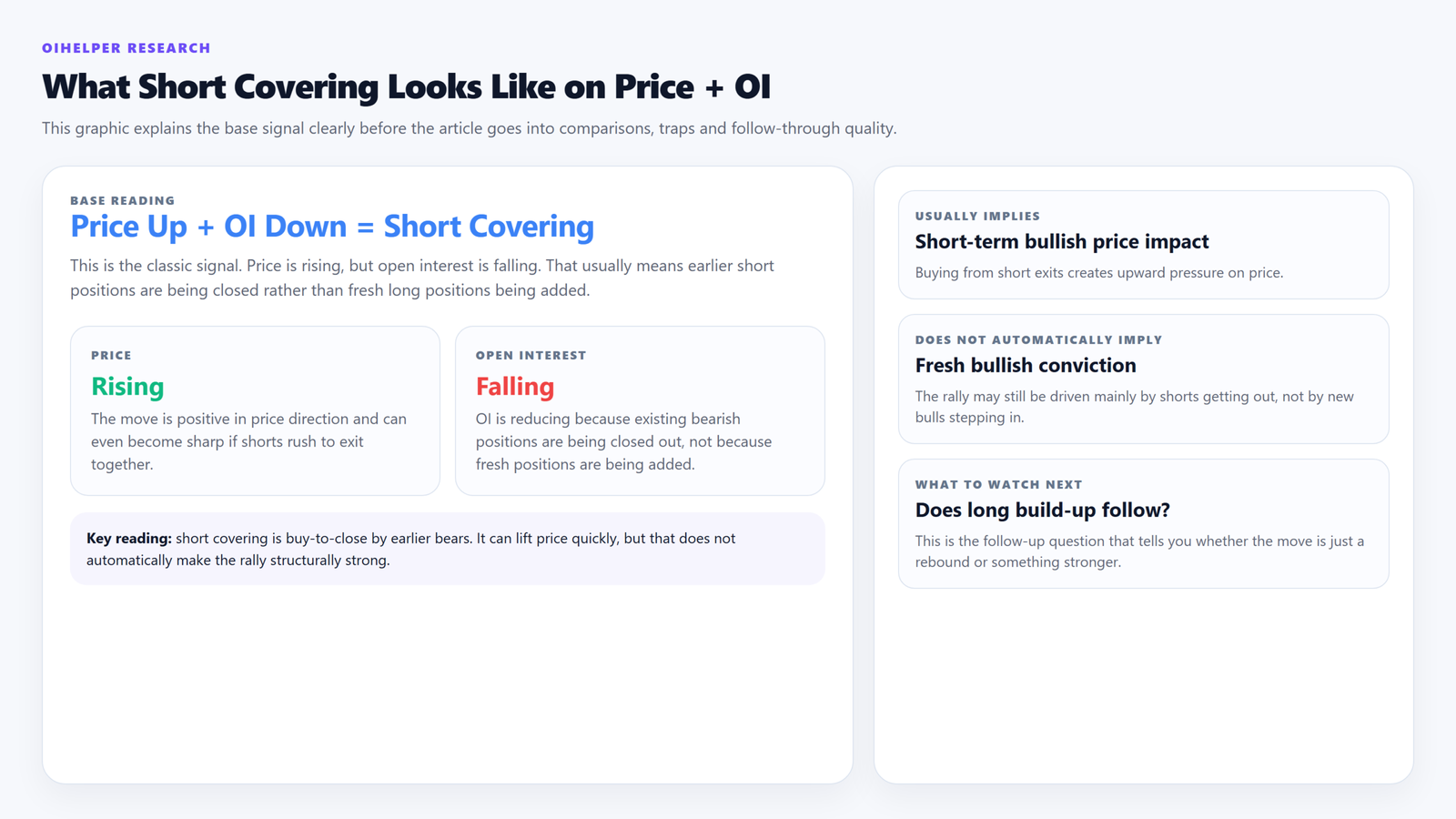
Short covering happens when traders who previously sold short buy back their position to close it.
In the price and open interest framework, short covering usually means:
– price rises
– open interest falls
This usually suggests that earlier short positions are being closed.
What short covering usually implies
- bearish positions are being reduced
- buying pressure is coming from short sellers exiting
- price can move up sharply in the short term
What it does not automatically imply
- that fresh bullish positions are being created
- that a strong uptrend has started
- that the move will continue after the covering ends
This is the most important point in the whole topic.
Why short covering happens
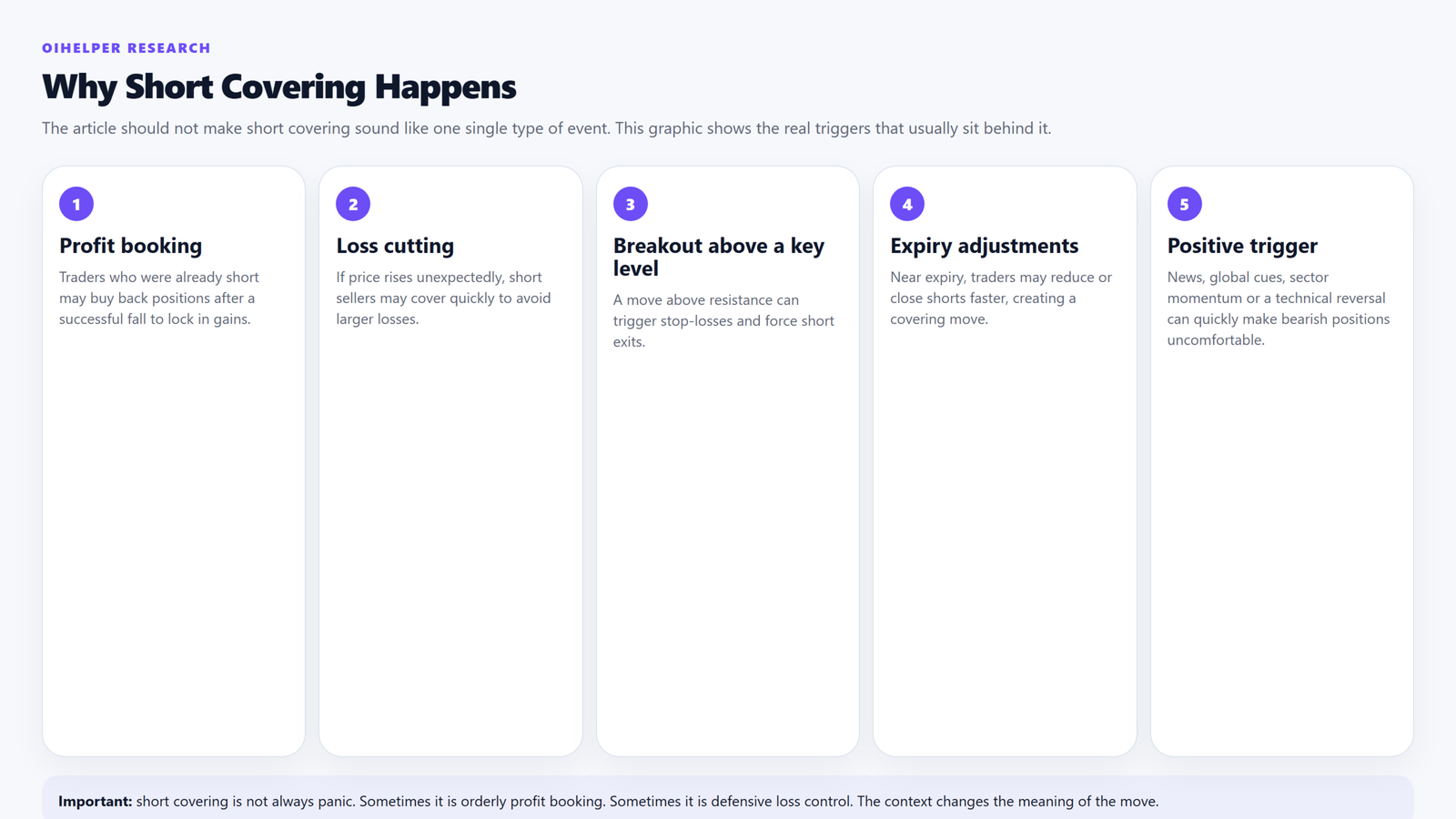
Short covering can happen for different reasons.
1. Profit booking by shorts
If traders sold short earlier and price has already fallen, they may buy back the position to lock in profits.
2. Loss cutting when price rises unexpectedly
If price starts moving higher instead of lower, short sellers may cover quickly to avoid deeper losses.
3. Breakout above a key level
A move above resistance can trigger stop-losses for shorts and force exits.
4. Expiry-related adjustment
Near expiry, traders may close positions faster, which can create short-covering moves.
5. Positive trigger or reversal in sentiment
Sometimes a news event, a global cue, or even a technical reversal is enough to push shorts out of the trade.
So short covering is not always panic. Sometimes it is calm profit booking. Sometimes it is defensive loss control.
How to identify short covering
The classic signal is:
– price up
– OI down
That is the starting point.
But a stronger reading also checks:
– how sharp the move is
– whether volume is supportive
– whether bearish positioning was crowded earlier
– whether the rally shows follow-through after the initial move
This becomes easier to read when you understand whether positioning is being added or reduced now.
Is short covering bullish or bearish?
This is one of the most common questions.
The best answer is:
– short covering is bullish in price impact
– but not always bullish in conviction
That means price may rise during short covering, and the move may even be sharp. But that does not automatically mean the market has become structurally bullish.
A useful way to think about it is this:
Short covering can lift the market, but it does not always strengthen the market.
That is why traders should not confuse every sharp rally with genuine fresh bullish build-up.
Short covering vs long build-up
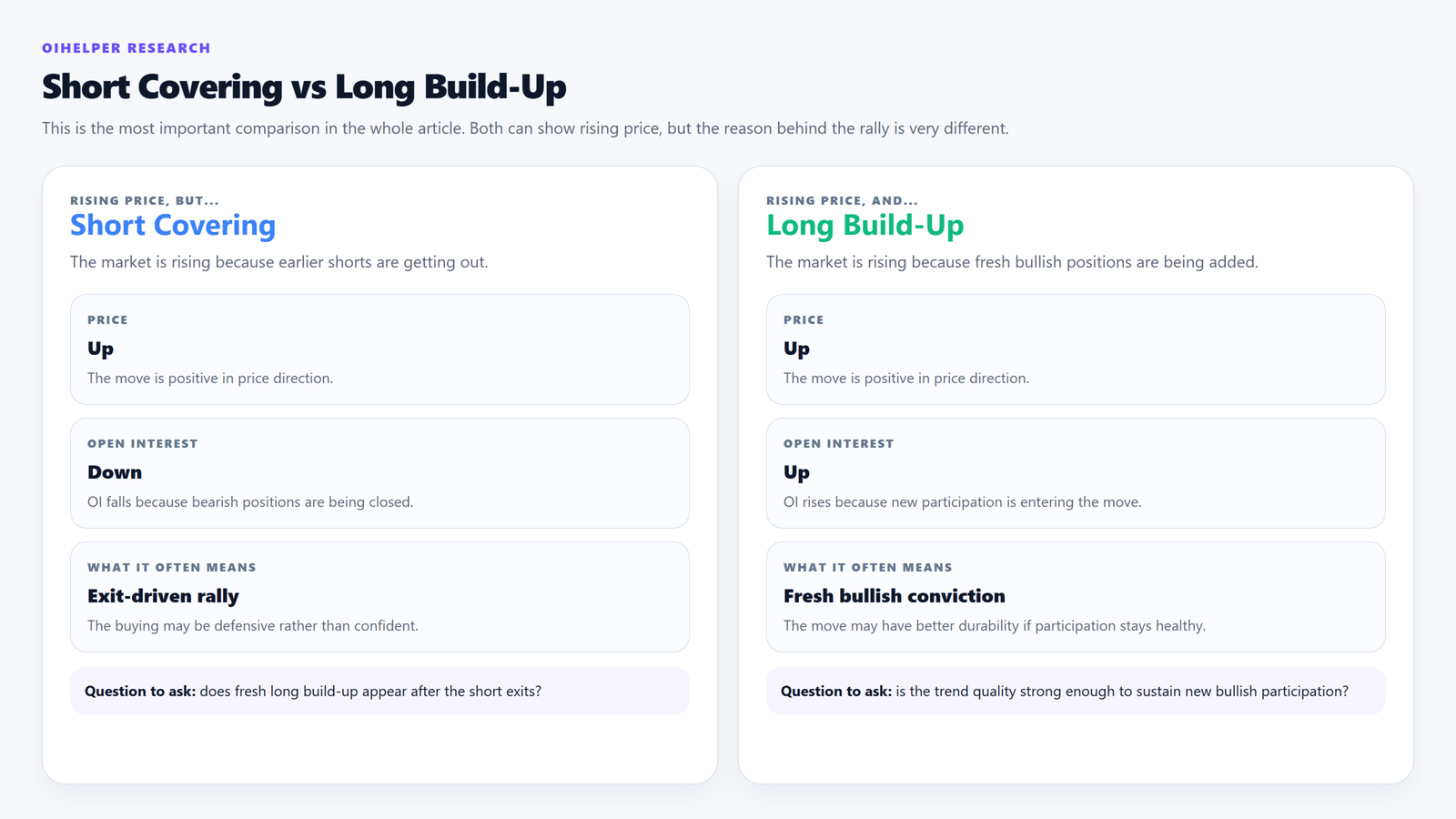
This is the most important comparison for this page.
Both can show rising price. But the reason behind the move is different.
| Factor | Short covering | Long build-up |
|---|---|---|
| Price | Rising | Rising |
| OI | Falling | Rising |
| Main driver | Shorts exiting | Fresh longs entering |
| Conviction | Can be temporary | Often stronger if supported by participation |
| What to check next | Whether fresh longs follow | Whether trend quality holds |
The practical difference
- Short covering means earlier bears are getting out.
- Long build-up means fresh bulls are stepping in.
A simple way to remember it:
One rally is driven by short sellers getting out. The other is driven by fresh buyers stepping in.
This is why a short-covering rally can look bullish but still fail to turn into a stronger trend.
If you want the full comparison context, this sits inside the broader price and open interest framework.
Short covering vs short squeeze
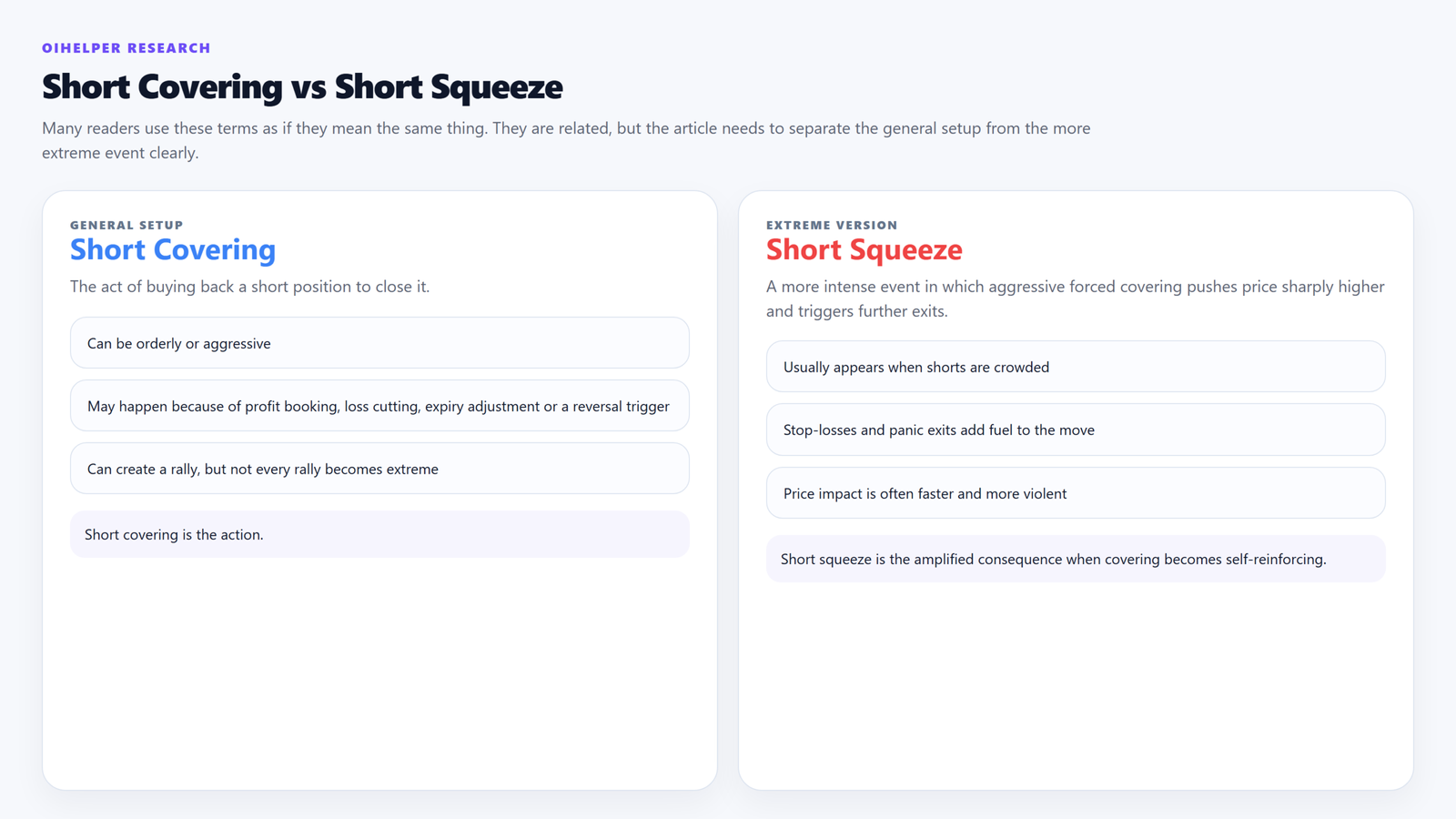
These two terms are related, but they are not the same.
Short covering
This is the act of buying back a short position to close it.
Short squeeze
This is a more extreme event in which many short sellers are forced to cover aggressively, which pushes price up even more and triggers further exits.
Simple rule
Every short squeeze involves short covering, but not every short-covering move becomes a short squeeze.
This is an important distinction because traders often use the two terms as if they mean the same thing.
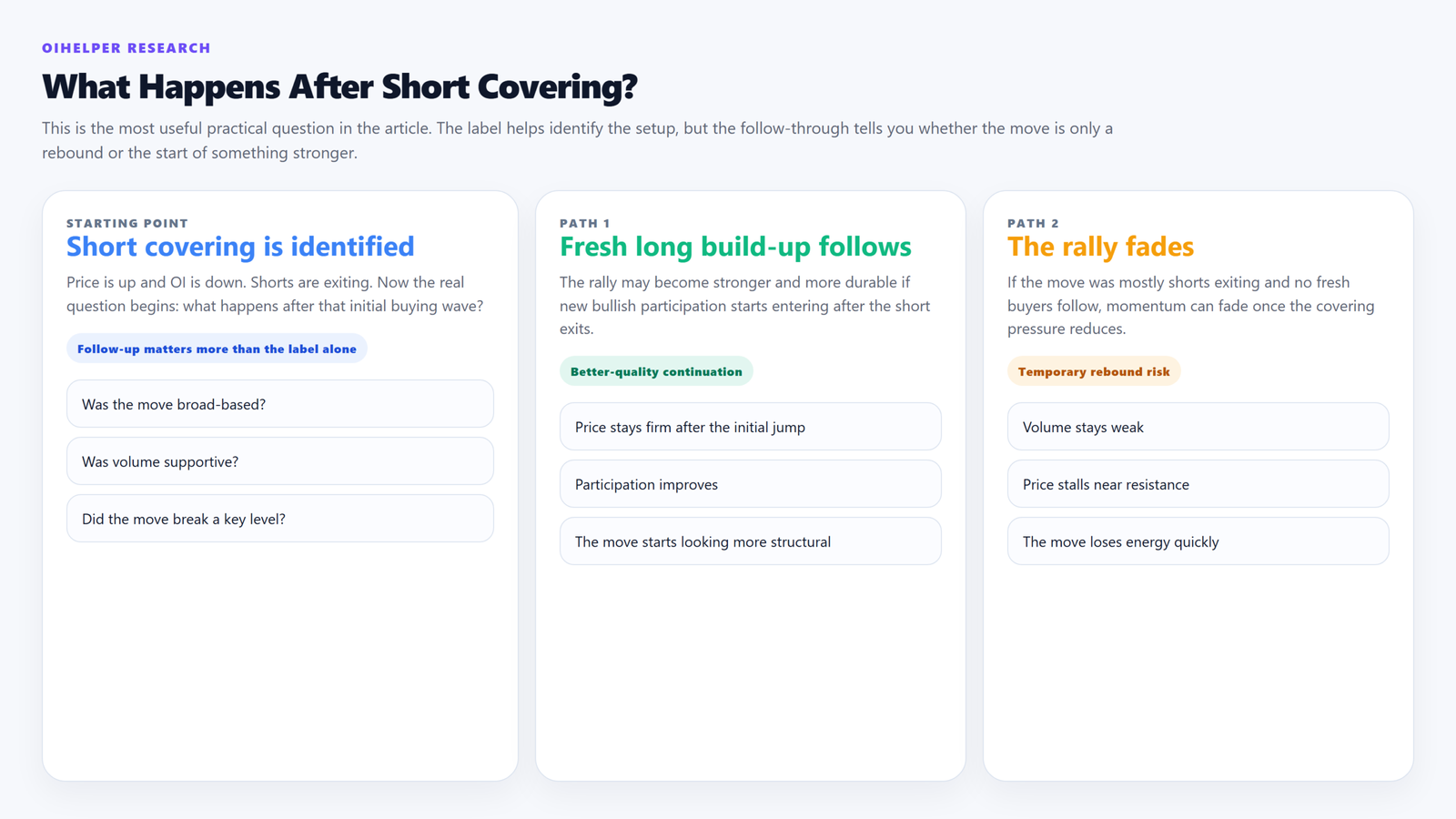
What happens after short covering?
This is one of the most useful questions in practice.
After short covering, one of two things often happens:
1. Fresh long build-up follows
If fresh long participation enters after the covering, the move may become stronger and more durable.
2. The rally fades
If the move was mainly driven by shorts exiting and no fresh bullish participation follows, the price rise may lose momentum.
This is why the best follow-up question is not just:
– was there short covering?
It is:
– what happened after the short covering?
That is where the quality of the read improves.
When short covering is more useful and reliable
Short covering often matters more when:
– bearish positioning was already crowded
– price moves above an important trigger or resistance level
– volume supports the move
– the market had become one-sided on the short side
– the covering is followed by healthier participation
These situations can produce strong rebounds.
When short covering can mislead
Short covering can also create weak interpretation if traders overread it.
Be more careful when:
– the move happens on weak volume
– the rally runs into overhead resistance quickly
– expiry is near and OI data becomes noisier
– there is no follow-through after the first bounce
– traders mistake short covering for fresh long build-up
That is why volume can help confirm whether the rally has real participation.
Can short covering happen in futures and options?
Yes, but it is most natural to explain short covering in a price + OI trend-reading framework, especially in futures.
In options, the language can become more complicated because traders also talk about:
– call short covering
– put short covering
– strike-level OI shifts
– expiry adjustments
So the core logic is still useful, but it should be applied carefully.
Before going too deep into these readings, it helps to understand how open positions still active in the market are counted in the first place.
A practical workflow for reading short covering
Use this simple process:
1. Check price direction
Is price moving higher?
2. Check OI direction
Is open interest falling?
3. Ask what that implies
If price is up and OI is down, shorts may be closing positions.
4. Check the context
Was bearish positioning crowded? Did price break a key level? Is there a clear reversal trigger?
5. Check whether fresh longs appear next
This is the most important follow-up question.
6. Confirm with volume and structure
A short-covering rally with no real participation may not last.
Practical comparison table
| Factor | Short covering |
|---|---|
| Price | Up |
| Open interest | Down |
| Main meaning | Existing short positions are being closed |
| Broad effect | Bullish in price impact |
| Key caveat | Not automatically a durable bullish signal |
Common mistakes traders make with short covering
| Mistake | Why it is weak | Better reading |
|---|---|---|
| Treating short covering as the same as long build-up | Shorts exiting is not the same as fresh longs entering | Check whether OI is falling or rising |
| Assuming every short-covering rally is a reversal | The move may only be temporary | Watch whether fresh long build-up follows |
| Ignoring volume | A weak move may not carry quality | Confirm participation with volume |
| Ignoring expiry context | OI moves can become noisier near expiry | Use more caution around expiry |
| Confusing short covering with short squeeze | A squeeze is the more extreme version | Separate the event from the general setup |
Conclusion
Short covering means old bearish positions are being closed. It does not automatically mean fresh bullish positions are being created.
That is the key lesson.
In practical terms:
– short covering usually pushes price higher
– but the move may be defensive rather than confident
– the real question is whether fresh long build-up follows after the covering
So when you see a rally, do not stop at the price move alone.
Ask what kind of participation is actually behind it.
That is what makes short covering useful to read properly.
