Open interest vs volume is one of the most misunderstood comparisons in options trading. Both numbers appear in the option chain, both relate to market activity, and both matter. But they do not answer the same question.
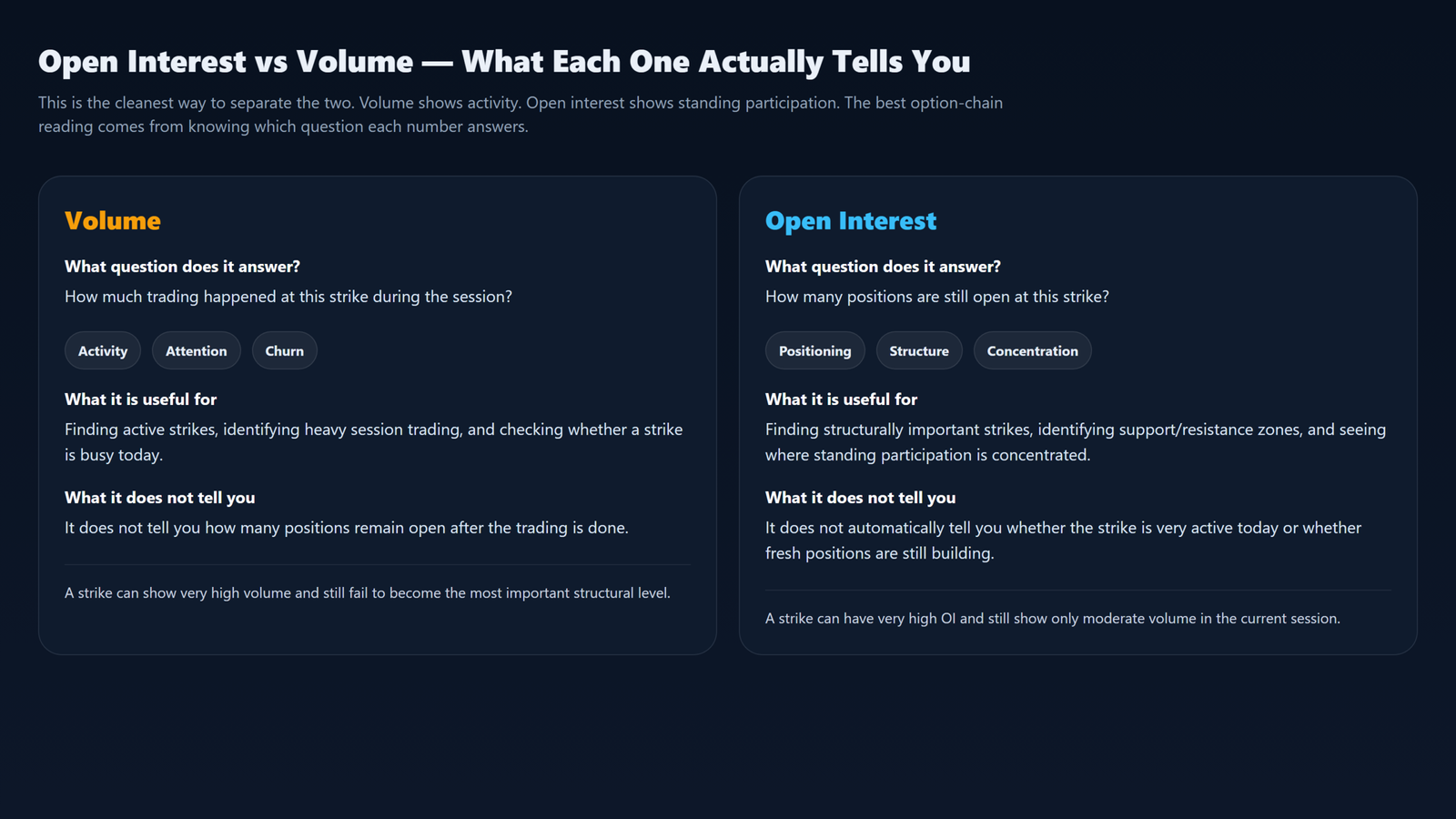
Volume shows how much trading happened during the session. Open interest shows how many positions are still open. That difference sounds simple, but many traders still confuse activity with positioning.
This article will help you understand how OI and volume should be read together in the option chain.
What volume means in the option chain
Volume is the number of contracts traded during the session or during the selected time period.
If option volume is high at a strike, it means that strike has seen strong trading activity. At any strike, both calls and puts can see heavy trading during the session. That activity may come from:
– fresh entries
– exits from existing positions
– intraday churn
– expiry-related trading
What high volume usually tells you
- the strike is active
- traders are paying attention to it
- trading interest is strong there during the session
What volume does not tell you on its own
- whether the positions are still open
- whether the strike is structurally important
- whether the strike has become a strong support or resistance level
What open interest means in the option chain
Open interest is the number of positions that remain open at a strike.
If OI is high, it usually means the strike has stronger standing participation. That gives it more structural importance in the option chain.
What high OI usually tells you
- the strike has meaningful participation
- the level may matter structurally
- the strike may be relevant for support, resistance or positioning concentration
What high OI does not tell you on its own
- whether the strike is very active today
- whether fresh positions are being added now
- whether the level is strengthening or weakening in the current session
Open interest vs volume — the direct difference
| Metric | What it shows | Main question it answers |
|---|---|---|
| Volume | Contracts traded during the session | How active was this strike today? |
| Open Interest | Contracts still open | How much positioning remains at this strike? |
The simplest distinction is this:
– volume shows activity
– OI shows positioning
Busy strike vs important strike
This is one of the best ways to understand open interest vs volume.
A strike can be a busy strike without being the most important strike.
Busy strike
A busy strike usually has:
– high volume
– fast trading activity
– strong participation during the current session
Important strike
An important strike usually has:
– higher OI
– meaningful change in OI
– stronger structural relevance near spot
Sometimes the busy strike and the important strike are the same.
Sometimes they are not.
This is one of the biggest practical differences between OI and volume. It becomes even more useful when you try to read the option chain in a structured way.
Why high volume can happen even when OI is low
High volume with low or flat OI often means the strike is very active, but that activity is not creating large standing positions.
This can happen because:
– traders are entering and exiting quickly
– there is heavy intraday churn
– expiry trading is inflating activity
– the strike is active for short-term reasons only
Practical reading
High volume with low or flat OI usually means:
– strong activity
– but not necessarily strong structural significance
In simple terms, the strike is busy, but it may not be one of the most important structural levels.
Why OI can be high even when volume is moderate
A strike can also have high OI while session volume is not especially large.
That usually means:
– the strike already carries old standing positions
– the level may still be structurally important
– the strike matters even if today’s trading is not extreme
This is one reason OI usually matters more than raw volume when traders are trying to identify support and resistance using open interest.
Why OI and volume should be read together
The strongest reading comes from combining both.
Volume tells you whether the strike is active.
OI tells you whether the strike is carrying meaningful positioning.
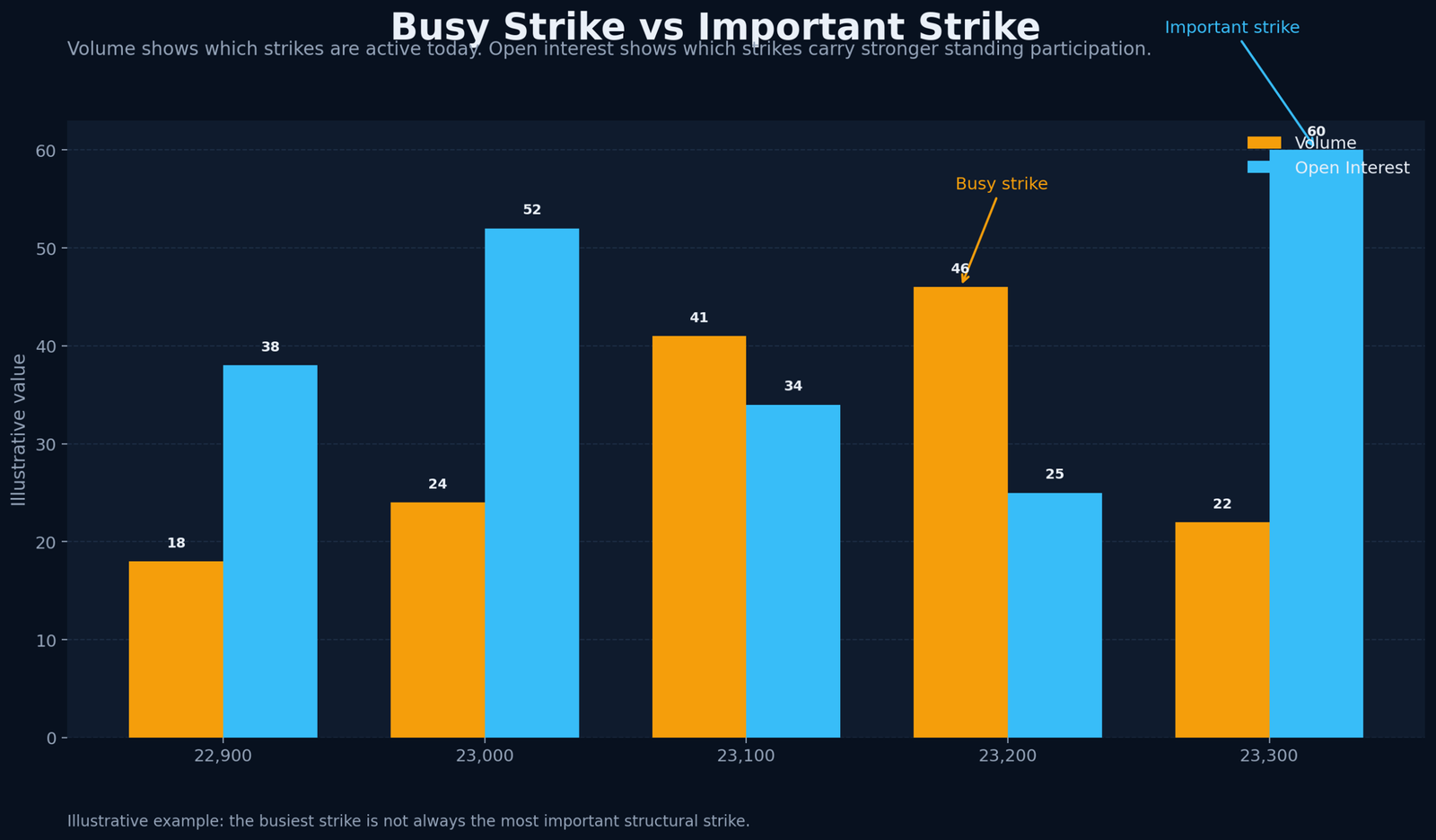
The chart below should be read with that distinction in mind. It helps compare a strike that is active today with a strike that is more important structurally.
A practical interpretation matrix
| Situation | Likely reading | What to check next |
|---|---|---|
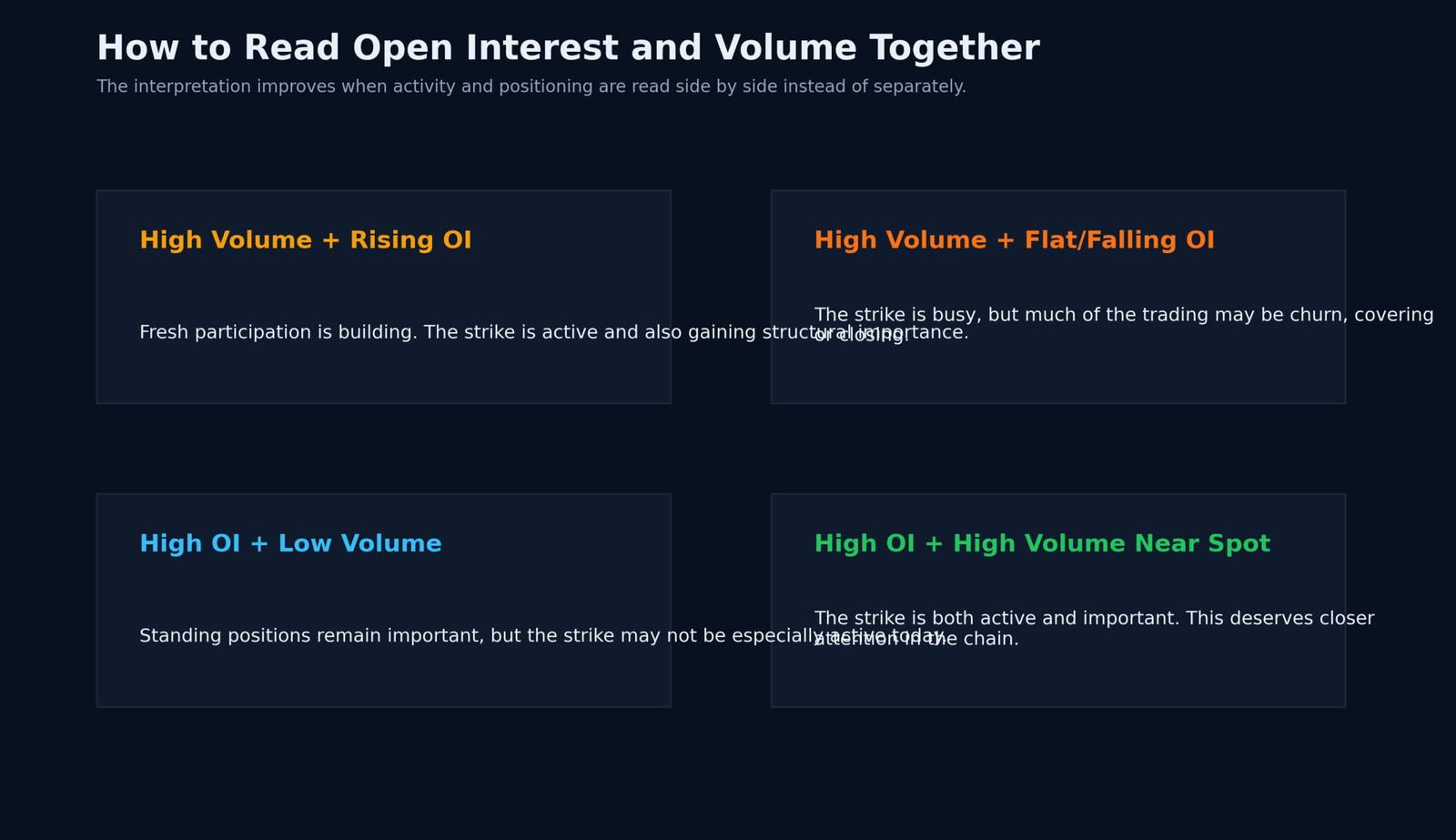
| High volume + rising OI | Fresh participation is building | Check whether the strike is near spot |
| High volume + flat or falling OI | Trading is active, but not all activity is creating new positions | Check for churn or position closing |
| High OI + low volume | Strong standing positions remain | Check whether the strike is still relevant near the live market |
| High volume + high OI near spot | The strike is both active and important | Watch it closely as a key level |
| Low volume + low OI | Limited relevance in the current structure | Avoid over-reading it |
Which matters more in support and resistance reading?
For structural support and resistance, OI usually matters more than raw volume.
That is because support and resistance depend more on standing participation than on temporary activity. Volume still matters, but usually as a confirmation of whether the strike is active in the current session.
Practical rule
- OI is better for structural reading
- volume is better for confirming session activity
- change in OI improves the quality of the interpretation further
Example: strike-wise OI and volume reading
| Strike | Volume | Open Interest | Change in OI | Practical reading |
|---|---|---|---|---|
| 22,900 | 18 lakh | 38 lakh | +2 lakh | Active enough, but not the strongest structural level |
| 23,000 | 24 lakh | 52 lakh | +8 lakh | Strong structural level with fresh participation |
| 23,100 | 41 lakh | 34 lakh | +4 lakh | Busy strike near spot, but not the strongest OI base |
| 23,200 | 46 lakh | 25 lakh | +2 lakh | Very active, but structurally weaker than 23,000 |
| 23,300 | 22 lakh | 60 lakh | +22 lakh | Strong standing participation with strong fresh build-up |
What this table shows
- 23,100 and 23,200 may be the busiest strikes because volume is high.
- 23,000 may still be the stronger support zone because OI and fresh OI build-up are stronger there.
- 23,300 may not be the busiest strike, but it is still important because OI is large and fresh OI change is also strong.
This is the main lesson:
The busiest strike is not always the most important strike.
Common mistakes traders make with OI and volume
| Mistake | Why it is weak | Better reading |
|---|---|---|
| Treating volume as positioning | Volume only shows traded activity | Use OI to judge standing participation |
| Treating OI as fresh activity | High OI can be old or stale | Check change in OI and volume |
| Ignoring spot distance | A distant strike may look big but may not matter now | Focus on nearby strikes first |
| Assuming the busiest strike is the strongest level | Activity does not always equal structure | Compare volume, OI and change in OI together |
| Ignoring expiry or session context | Activity can be distorted | Read volume in context |
A simple workflow for reading OI and volume together
Use this five-step process:
1. Note the current spot price
Without spot price, strike-wise numbers lose context.
2. Mark high OI strikes near the market
These are your first structural levels.
3. Check which of those strikes are also active on volume
This tells you whether the strike is only important structurally or also active today.
4. Compare change in OI
This helps show whether positions are building, reducing or simply rotating.
5. Decide whether the strike is busy, important, or both
That final distinction improves option-chain reading considerably.
How to use this in practice
The best use of OI and volume is not to create one rigid signal. It is to improve the quality of your market reading.
For example:
– if a strike has very high volume but weak OI, it may be active but not structurally dominant
– if a strike has high OI and rising change in OI, it may matter more even if session volume is not the highest
– if a strike has both high OI and strong volume near spot, it deserves much closer attention
Conclusion
Open interest and volume are not the same, and they should not be used as if they are interchangeable.
The most practical distinction is this:
– volume shows how much trading happened
– open interest shows how much positioning remains open
A better option-chain reading comes from combining:
– volume
– open interest
– change in OI
– distance from spot
– the difference between a busy strike and an important strike
That approach gives a better interpretation than using either metric in isolation.
